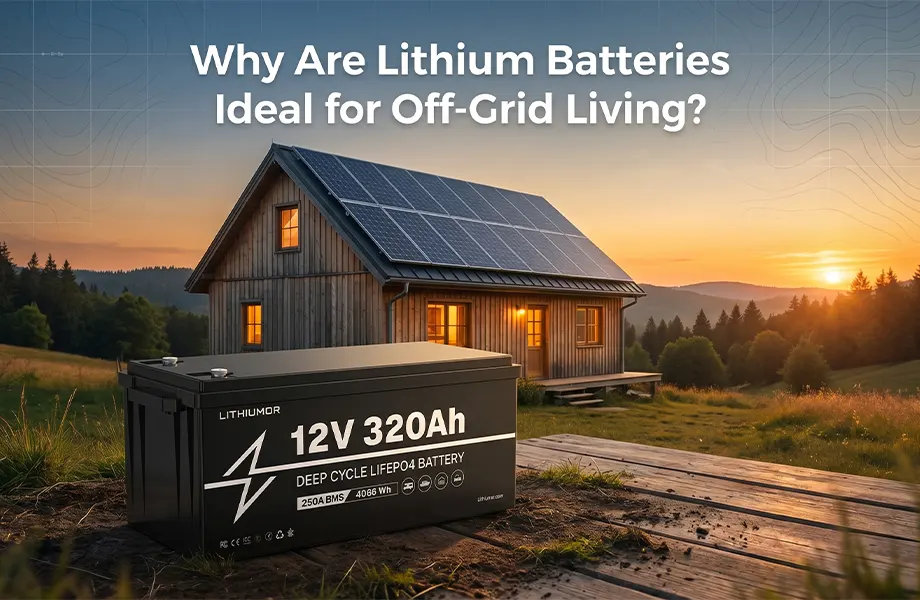
There is a moment every off-grid homeowner knows well. The sky has been overcast for three days, the solar panels are barely producing, and you find yourself doing mental math about how much power is left in your battery bank. In that moment, the battery is everything. It is not a background component. It is the entire system.
This is what separates off-grid power from grid-tied solar. When you live off the grid, your battery bank is not a backup. It is your primary source of power, and it needs to perform reliably through bad weather, seasonal shifts, heavy usage days, and years of daily cycling. Most batteries were not built with that reality in mind. The lithium LiFePO4 battery was.
What Makes Off-Grid Power Storage So Demanding?
To understand why battery chemistry matters so much, it helps to think about what an off-grid battery actually goes through on a daily basis. Unlike a grid-tied home that draws from solar when available and pulls from the utility grid otherwise, an off-grid system has no safety net. Your battery bank absorbs whatever the solar panels produce during the day and then powers your home through the evening and overnight. If the next day is cloudy, the battery does that again without fully recovering. And again the day after that. This means your battery is being discharged deeply and regularly. It is also being charged at varying rates depending on sun intensity, not at a controlled rate the way a factory charger works. Over the course of a year, that adds up to hundreds of demanding cycles. Lead-acid batteries, which have been the default choice for off-grid systems for decades, tolerate this kind of use poorly. They are designed to be kept near full charge and discharged only partially. Push them past 50% depth of discharge on a regular basis and their lifespan drops sharply. For an off-grid household drawing heavily on its battery bank every night, this means a lead-acid battery bank can wear out in just a few years. The demands of off-grid living require a deep cycle battery built for exactly that kind of repeated, deep cycling. That is where lithium iron phosphate chemistry earns its place.
Five Practical Reasons LiFePO4 Batteries Work So Well for Off-Grid Solar
1. Cycle Life That Matches Your Long-Term Commitment
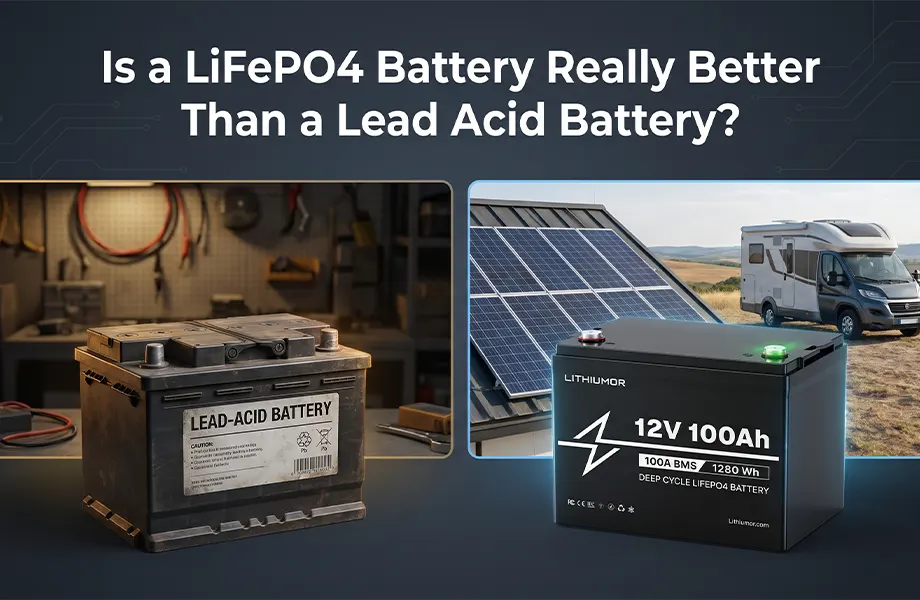
A quality LiFePO4 battery is typically rated for 3,000 to 5,000 charge cycles or more before it drops to 80% of its original capacity. Cycling once per day, that translates to roughly 8 to 14 years of useful life.
A standard flooded lead-acid deep cycle battery, by comparison, is usually rated for 300 to 500 cycles under similar conditions. If you are discharging it deeply each night, as most off-grid users do, you may be replacing it every two to three years.
Over a 10-year horizon, the LiFePO4 battery often costs less in total, even though its upfront price is higher. It just does not announce that saving at the point of purchase.
2. More of the Capacity You Pay For Is Actually Usable
A 100Ah lead-acid battery is typically recommended for use down to 50% state of charge. Below that, you are shortening its life meaningfully. So in practice, you have about 50Ah of usable capacity.
A 100Ah lithium battery can be discharged to 80% or even 100% depth of discharge regularly without significant damage. That means up to 100Ah of real, usable energy from the same rated capacity. When you are sizing a battery bank for an off-grid home, this difference cuts your required bank size roughly in half compared to lead-acid, for the same actual storage.
3. Better Charge Efficiency Means More Energy Captured From Solar
Solar panels produce power whenever the sun is up, but how much of that energy actually makes it into your battery depends on charge efficiency. Lead-acid batteries lose somewhere between 15% and 25% of incoming energy as heat during charging. LiFePO4 batteries operate at close to 99% round-trip efficiency, meaning nearly all the energy your panels produce is stored and available to use.
On a partially cloudy day when your panels are producing less than ideal output, that efficiency gap becomes very real. You keep more of every watt your system generates.
4. Lighter and Smaller for the Same Amount of Stored Energy
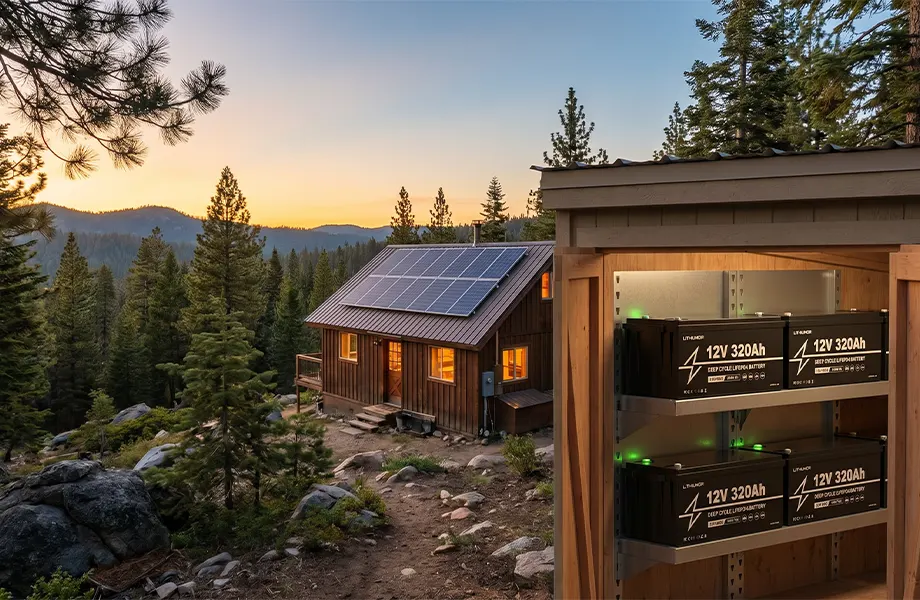
Lithium batteries carry significantly more energy per kilogram than lead-acid. Depending on the configuration, a lithium battery bank can weigh 50% to 70% less than a lead-acid bank storing the same usable energy. For a cabin floor, a van build, or any installation where structural load or space is a concern, that reduction is not trivial.
A smaller, lighter battery bank is also easier to install, expand, and reconfigure as your energy needs grow over time.
5. Low Maintenance Over the Long Run
Flooded lead-acid batteries require periodic water top-ups, equalization charges to prevent sulfation, and ventilation because they off-gas hydrogen during charging. Absorbed glass mat (AGM) lead-acid batteries skip the watering but still have limited cycle life and no tolerance for deep discharge.
A LiFePO4 deep cycle battery requires none of that. The built-in battery management system (BMS) handles cell balancing and protection automatically. You mount it, connect it, and get on with living off the grid. For people who moved off-grid specifically to simplify their lives, this matters.
How to Size a Lithium Battery Bank for an Off-Grid Home
Getting the sizing right is one of the most important decisions in an off-grid solar build. Too small a battery bank and you run out of power on low-sun days. Too large and you have spent money on capacity you rarely use.
A practical starting point is your daily energy consumption in kilowatt-hours. Go through your home and estimate how long each appliance runs per day, then add it up. Most off-grid households land somewhere between 2 kWh and 10 kWh per day depending on how they live and what they run.
From there, decide on your days of autonomy. This is the number of consecutive days you want to run on battery power without meaningful solar charging. Two to three days is a reasonable target for most climates. Multiply your daily consumption by that number, and you have your target usable battery capacity.
Because a LiFePO4 battery gives you up to 100% of its rated capacity as usable energy, the math is straightforward. If you need 15 kWh of usable storage, a 15 kWh battery bank gets you there.
You will also want to make sure your battery bank is sized to match your inverter’s continuous power draw and your solar charge controller’s charging capacity. A battery bank that is too small relative to your inverter will be stressed by high-draw appliances, and a solar array that is too large for your bank may produce more than your batteries can absorb efficiently.
Lithiumor’s deep cycle LiFePO4 batteries are built with series and parallel expansion in mind, so you can start with what you need today and add capacity as your household grows.
What to Look for When Buying a LiFePO4 Deep Cycle Battery
Not all lithium batteries are equal. Here is what to look at when comparing options.
BMS quality. The battery management system is the internal circuit that protects the cells from damage. A good BMS handles overcharge and over-discharge protection, over-temperature and under-temperature cutoffs, short-circuit protection, and cell balancing. Cheap batteries often cut corners on BMS quality, which shortens lifespan and reduces safety.
Bluetooth monitoring. The ability to check your battery’s state of charge, voltage, current, and cell health from your phone is a genuinely useful feature in an off-grid setup. It removes the guesswork from energy management and lets you spot a problem before it becomes a real one.
Warranty length. A manufacturer that offers a long warranty on a LiFePO4 battery is putting its money behind its own product. Warranties of 5 years or more are a reasonable baseline expectation for a quality deep cycle battery.
Series and parallel expandability. Your energy needs may grow. Buying a battery designed to be expanded in series or parallel means you are not locked into your initial capacity. Check that the manufacturer supports and specifies the configuration clearly.
The Bottom Line
Living off the grid is not a casual commitment. You are taking full responsibility for your own power supply, and every component in your system has to hold up its end of the deal through years of daily use, seasonal variation, and the occasional stretch of bad weather.
A lithium LiFePO4 battery holds up that end of the deal better than the alternatives available today. The combination of long cycle life, high usable capacity, excellent charge efficiency, low maintenance, and genuine safety makes it the most practical choice for anyone building or upgrading a serious off-grid solar system.
The upfront investment is real. So is what you get in return.
Explore Lithiumor’s range of deep cycle LiFePO4 batteries and find the right fit for your off-grid setup.